PhD report
Topic : Electrical engineering
Back -
Retour
Soutenance : 2 juin 2026
ECOLE CENTRALE DE LILLE, France
Mohamad EL IAALI
Utilisation Des Véhicules Électriques dans un Système de Gestion de la Flexibilité :
Une Approche Fondée sur un Jumeau Numérique
Using Electric Vehicles in a Flexibility Management System:
A Digital Twin Based Approach
President :
Carlos CANUDAS-DE-WIT, Directeur de Recherche CNRS, GIPSA-Lab
Rapporteurs :
Robin ROCHE, Professeur, Université Marie et Louis Pasteur, FEMTO-ST Institute
Marc PETIT, Professeur, CentraleSupélec, GeePS
Examinatrice :
Nathalie Marion Frieß, Docteure, Graz University
Encadrants:
Antoine BRUYÈRE, Maître de conférences, Centrale Lille Institut, L2EP
João SOARES, Chargé de recherche, ISEP Porto, GECAD
Zita VALE, Professeure, ISEP Porto, GECAD
Bruno FRANCOIS, Professeur des Universités, Centrale Lille, L2EP
Invité:
Olivier BEAUDE, Dr Ingénieur, EDF R&D
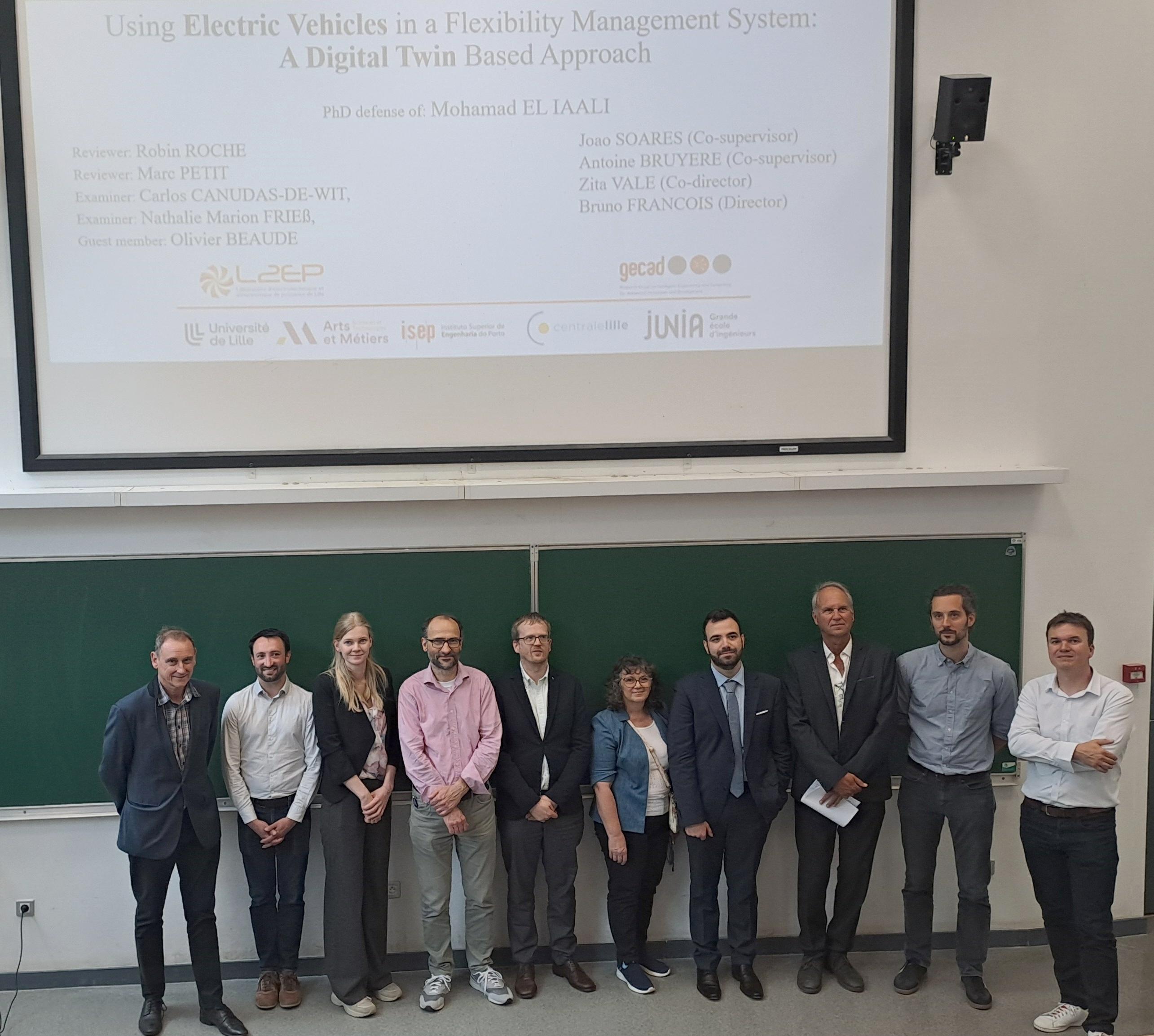
Proclamation des résultats
Abstract:
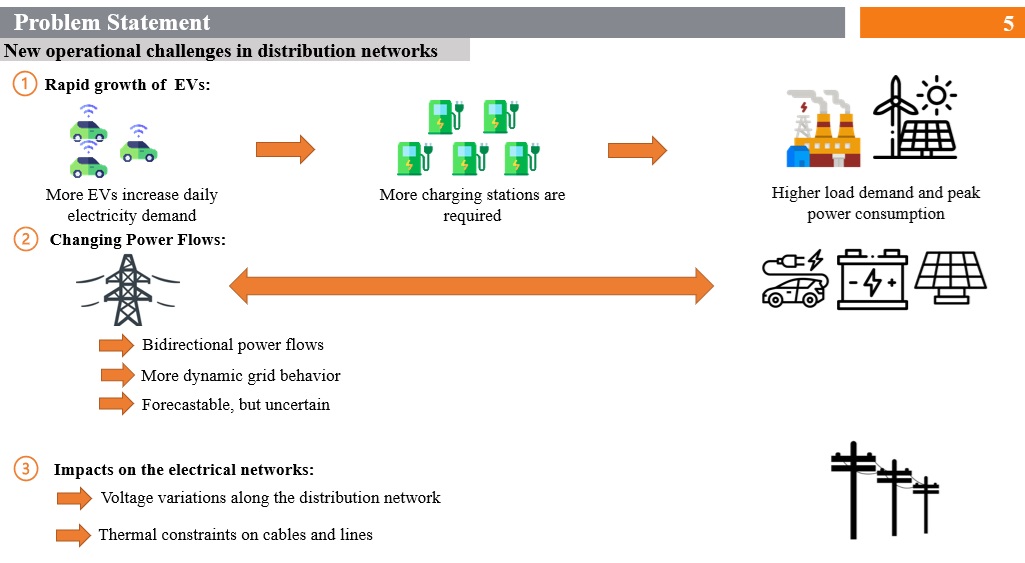
Faced with the development of renewable energies and new types of load demands in electrical
distribution networks, flexibilities are needed to enable optimal network operation in order to improve
resilience, reduce maintenance and operating costs, and minimize environmental impact. Electric vehicle
(EV) charging can be used to provide these services for network operation. Thus, so-called smart charging
of parked electrical vehicles can enable local consumption of distributed generation (DG) at times
favorable to the network operator. To achieve this, electrical infrastructure requires monitoring of its
dynamic constraints and anticipation of the factors that influence the network's dynamic operation.
Initially, this research project proposes an applied method for developing a digital twin of the electrical
network based on a physical model to enable the interpretation of data generated by the AI methods
used. Next, this digital twin is used to formulate and design an operational management system for this
flexibility, consistent with the variable constraints of the distribution network and the vehicle availability
wishes of their users. Examples of practical, real-time implementation are provided.
Résumé:
Face au développement des énergies renouvelables et de nouveaux modes de consommation dans les
réseaux électriques de distribution, des flexibilités sont nécessaires pour permettre une exploitation
optimale de ces réseaux afin d'en améliorer la résilience, de réduire les coûts de maintenance et
d'exploitation et de minimiser l'impact environnemental. La recharge des véhicules électriques (VE) est
utilisable pour fournir ces services pour le fonctionnement du réseau. Ainsi, la recharge dite intelligente
des véhicules stationnés peut permettre la consommation locale de la production distribuée (DG) à des
moments favorables pour le gestionnaire de réseau. Pour y parvenir, les infrastructures électriques
nécessitent une surveillance de leurs contraintes dynamiques et une anticipation des facteurs qui
influencent le fonctionnement dynamique du réseau.
Dans un premier temps, ces travaux de recherche proposent une méthode appliquée pour le
développement d’un jumeau numérique de réseau électrique en se basant sur un modèle physique afin
de permettre une interprétation des données générées par les méthodes d’IA utilisées.
Ensuite, ce jumeau numérique est mis à profit pour formuler et concevoir un système de gestion
opérationnelle de cette flexibilité en cohérence avec les contraintes variables du réseau de distribution et
les souhaits de disponibilité des véhicules par leurs utilisateurs. Des exemples de mise en oeuvre pratiques
en temps réel sont proposées.
Contenu :
Chapter 1: Context, objective, and scope of the thesis
Chapter 2: State Estimation techniques for enhanced monitoring in low voltage distribution networks
Chapter 3 : Implementation and validation of state estimation for distribution network monitoring in a real-time simulation framework
Chapter 4: Flexibility management systems for smart charging of plug-in electric vehicles
Chapter 5: Real-time implementation and validation of a flexibility management system
Conclusion
download the presentation
Publications:
International conferences
[C1]
Distribution Network Digital Twin: A Basic Machine Learning-Based Voltage Estimator,
M. EL IAALI, R. RAZI, A. BRUYERE, B. FRANCOIS, and J. SOAREs
IEEE International Conference on Communications, Control, and Computing Technologies for Smart Grids (SmartGridComm), 2023
[C2]
A Novel Cascading Artificial Neural Networks for Enhanced Distribution Network State Estimation,
M. EL IAALI, R. RAZI, A. BRUYERE, B. FRANCOIS, and J. SOARES
IEEE 22nd Mediterranean Electrotechnical Conference (MELECON), 2024
[C3]
Machine Learning Methods for State Estimation in Sparse Distribution Networks,
M. EL IAALI, R. RAZI, A. BRUYERE, B. FRANCOIS, J. SOARES, and Z. VALE
IEEE Conference on Artificial Intelligence (CAI), 2025
[C4]
A Digital Twin for Flexibility Management in Distribution Network,
M. EL IAALI, R. RAZI, A. BRUYERE, B. FRANCOIS, J. SOARES, and Z. VALE
IEEE Symposium Series on Computational Intelligence (SSCI 2025), Trondheim, Norway, 2025.
[C5]
Machine Learning Approach for Predictive Voltage-Constrained Power Capacity in Distribution Networks with Electric Vehicles
M. EL IAALI, R. RAZI, A. BRUYERE, B. FRANCOIS, J. SOARES, and Z. VALE
IEEE 23rd Mediterranean Electrotechnical Conference (MELECON), 2026
[C6]
Estimation of Electrical Quantities in Distribution Networks Using GNN and Cascaded ANN: A Performance Comparison
M. EL IAALI, R. RAZI, A. BRUYERE, B. FRANCOIS, J. SOARES, and Z. VALE
IMACS TC ELECTRIMACS (ELECTRIMACS), 2026
[C7]
Multi-Objective Optimization Approach for Load Smoothing and Rapid PEV Charging in Low-Voltage Networks
M. EL IAALI, J. SOARES, S. LIMMER, A. BRUYERE, B. FRANCOIS, and Z. VALE,
8th International Conference on Smart Energy Systems and Technologies (SEST), Ciudad Real, Spain, 2026
National conferences
[N1]
“Un réseau de neurones artificiels pour l’estimation rapide de l’état d’un réseau de distribution de basse tension,”
M. EL IAALI, R. RAZI, A. BRUYERE, B. FRANCOIS, and J. SOARES,
Conférence des Jeunes Chercheurs en Génie Électrique (JCGE), 2024.