PhD report
Topic : Electrical engineering
Back -
Retour
Soutenance : 21 novembre 2025
ECOLE CENTRALE DE LILLE, France
Antonella TANNOUS
Approches par Apprentissage Profond pour le
Contrôle Prédictif et Adaptatif des Systèmes de Stockage par Batteries pour la
Provision de Réserves de Puissance électrique à Court Terme
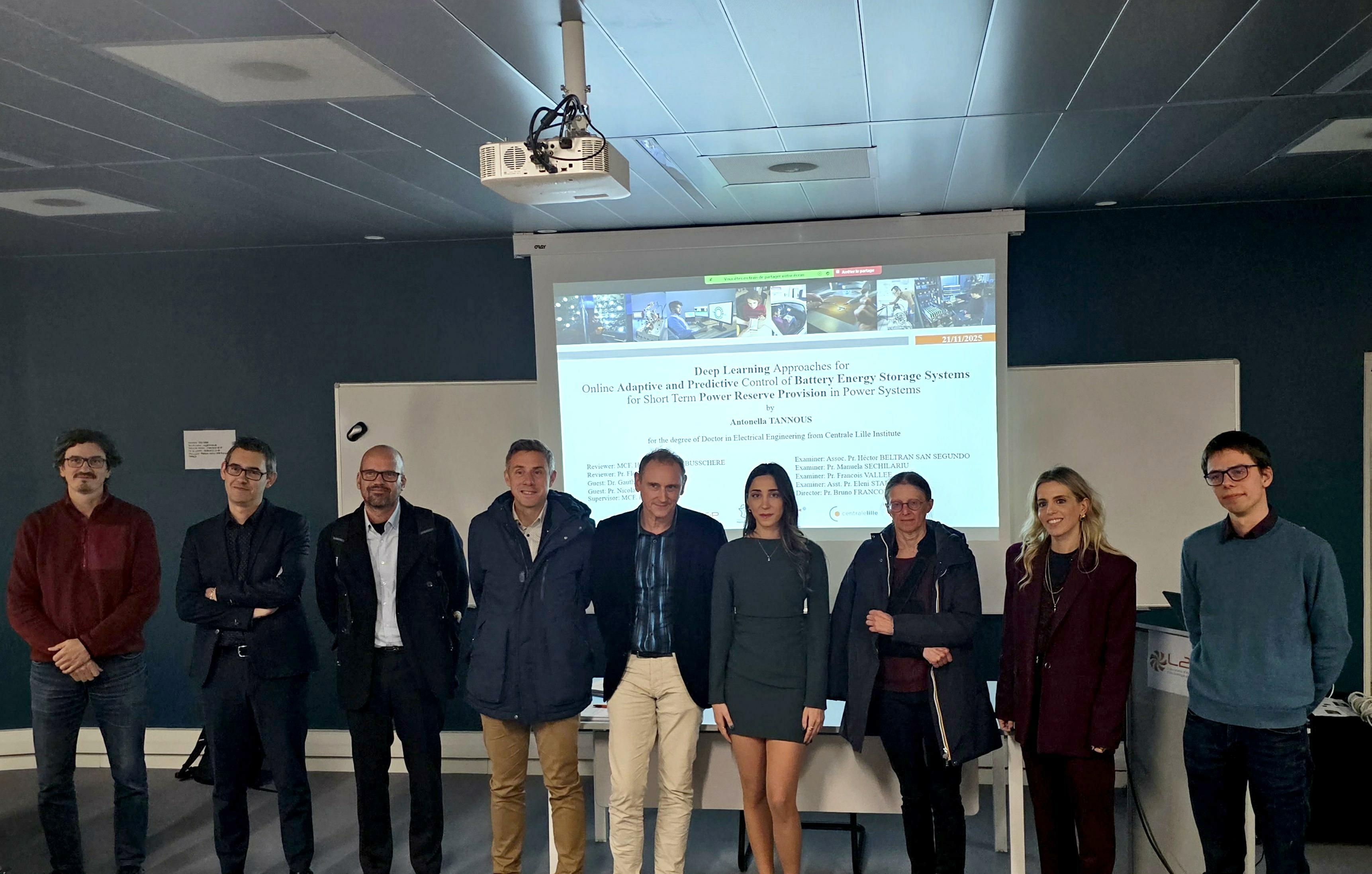
Deep Learning Approaches for
Online Adaptive and Predictive Control of Battery Energy Storage Systems for
short term Power Reserve Provision in Power Systems
President :
François VALLEE, Professeur, Université de Mons, PSMR, Belgique
Rapporteurs :
Vincent DEBUSSCHERE, Dr. HDR, Grenoble INP, G2ELAB
Florence OSSART, Professeur, Sorbonne Université, GEEPS
Examinatrice :
Eleni STAI, MCF, Assistant Prof., NTUA, Greece
Héctor BELTRAN SAN SEGUNDO, Associate Prof., Universitat Jaume I, Espagne
Manuela SECHILARIU, Professeur, UTC, Avenues
Encadrants:
Ferréol BINOT, Dr. Maître de Conférences, Centrale Lille Institut, L2EP
Bruno FRANCOIS, Professeur des Universités, Centrale Lille, L2EP
Membres Invités:
Gauthier DELILLE, Dr. Ingénieur, EDF R&D
Nicolas FERLAY, Dr. Maître de Conférences, Université de Lille, LOA
Abstract:
The inherent variability of wind- and solar-based Renewable Energy Sources disrupts the traditional power–frequency coupling and
challenges grid balancing, thereby creating a demand for fast, low-cost, and low-emission active power reserves. Addressing this challenge
requires adaptive, model-free control strategies that incorporate new stability indicators and overcome the limitations of conventional
techniques. This study proposes a model-free adaptive control strategy based on a Deep Neural Network (DNN) to balance power in real
time under renewable generation and load fluctuations, while minimizing frequency deviation, operating costs and CO2 emissions. The
developed controller dynamically manages power reserve allocation from a Battery Energy Storage System (BESS) by making proactive
minutely decisions for the next five minutes, using either historical measurements or very short-term forecasts. A benchmark Microgrid (MG)
case study is designed and simulated in MATLAB/Simulink to generate datasets for offline DNN training. The controller is then validated in
online operation. Technical, economic, and environmental performance indicators are employed to assess the strategy under realistic
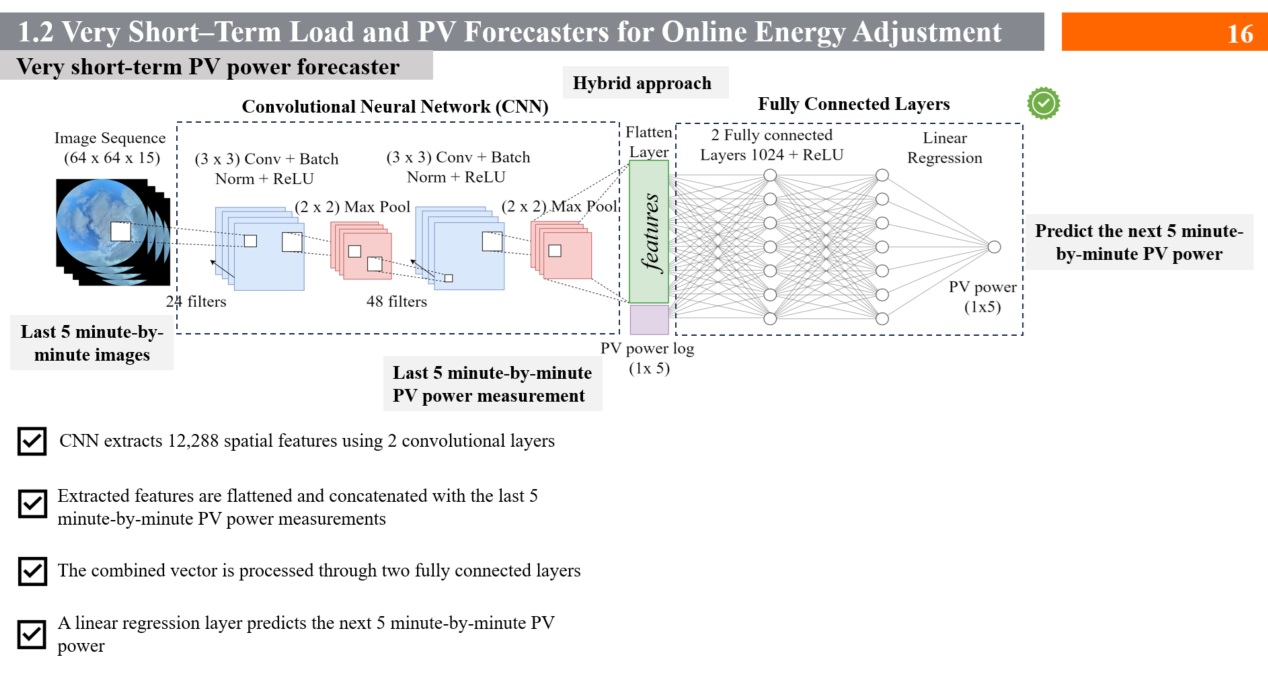
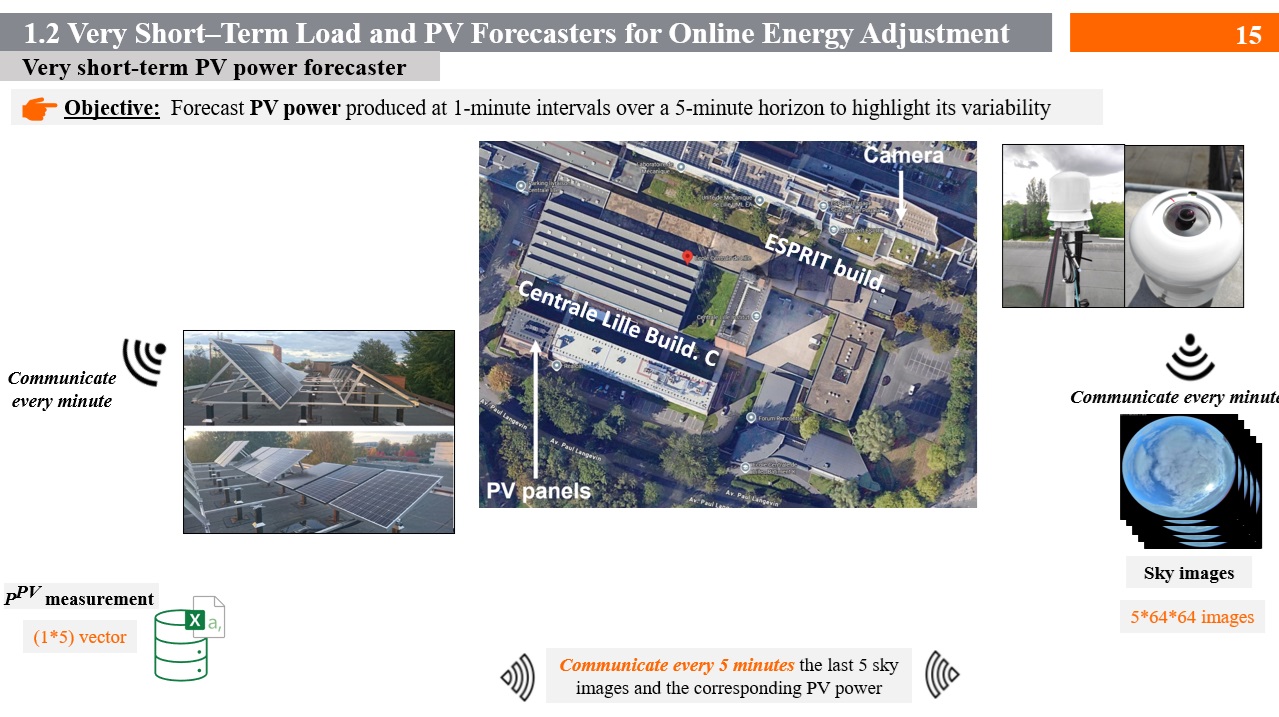
scenarios. As real measurements are difficult to obtain, the framework integrates very short-term forecasting. A Polynomial Ridge Regression
model is developed for load forecasting using historical demand data, while a hybrid Convolutional Neural Network (CNN) model is designed
for Photovoltaic (PV) forecasting using sky images and historical PV data. Results show that the proposed DNN-based control significantly
reduces frequency deviations, operating costs, and emissions compared to conventional droop control. The framework is validated in a realtime
co-simulation platform integrating SPHEREA and OPAL-RT simulators. This setup enables accurate validation under realistic conditions
while reducing simulation time compared to offline simulations. Finally, to enhance generalization across diverse power systems with various
renewable penetration and levels of synchronous generation, the framework is extended through Transfer Learning (TL). The control task
learned by a source DNN—trained with data from the original case study (source MG) —is fine-tuned via TL to produce a target DNN adapted
to the new power system configuration. The new power system is an optimally designed MG for self-consumption (target MG). It is obtained
through a bi-objective Mixed-Integer Linear Programming (MILP) optimization that minimizes annualized economic and environmental costs.
This process reduces training data and computation time while preserving high control performance. The successful performance of the
transfer-learned DNN confirms its ability to generalize across varying levels of renewable energy penetration and synchronous generation.
Résumé:
La variabilité intrinsèque des sources d’énergie renouvelable éoliennes et solaires perturbe le couplage traditionnel puissance–fréquence et
complique l’équilibrage du réseau, créant ainsi un besoin de réserves de puissance active rapides, peu coûteuses et faiblement émettrices
en CO2. Pour relever ce défi, il est nécessaire de recourir à des stratégies de commande capables de dépasser les limites des approches
conventionnelles basées sur la mesure de la fréquence et d’intégrer de nouveaux indicateurs de stabilité. Cette étude propose une stratégie
de commande conçue sans modèle physique, adaptative et fondée sur un réseau de neurones profonds (DNN), qui a pour objectif de
maintenir l’équilibre du réseau électrique face aux fluctuations de production renouvelable et de charge, tout en minimisant les coûts
d’exploitation et les émissions de CO2. Le contrôleur développé gère dynamiquement l’allocation des réserves d’un système de stockage par
batterie (BESS) en prenant, chaque minute, des décisions proactives pour les cinq minutes suivantes, à partir de mesures historiques ou de
prévisions très court terme. Un micro-réseau (MG) de référence est conçu et simulé sous MATLAB/Simulink pour générer les jeux de données
nécessaires à l’entraînement hors ligne du DNN. Le fonctionnement du contrôleur est ensuite validé en ligne. Des indicateurs techniques,
économiques et environnementaux permettent d’évaluer l’efficacité de la stratégie pour des scénarios réalistes. Comme les mesures sont
difficiles à obtenir avec un temps court, la stratégie intègre des prévisions à très court terme. Un modèle de régression polynomiale Ridge
est développé pour la prévision de la charge à partir des données historiques, tandis qu’un modèle hybride, s’appuyant sur un réseau de
neurones convolutifs (CNN) est conçu pour la prévision photovoltaïque (PV) en utilisant à la fois des images du ciel et des historiques de
production. Les résultats montrent que le contrôle proposé réduit significativement les écarts de fréquence, les coûts et les émissions par
rapport au contrôle classique par droop. La stratégie est validée sur une plateforme de co-simulation temps réel intégrant un simulateur
temps réel de réseau OPAL-RT et calculateur temps réel SPHEREA. Cette configuration permet une validation précise dans des conditions
réalistes tout en réduisant le temps de simulation par rapport aux approches hors ligne. Enfin, pour généraliser le contrôle à des réseaux
comportant des taux variables de pénétration renouvelable et de générateur synchrone, la stratégie de contrôle apprise par le DNN source
est ajustée via un apprentissage par transfert pour produire un DNN cible adapté au réseau électrique concerné. Il est testé sur un MG
optimisé pour l’autoconsommation (MG cible), qui est obtenu par une optimisation MILP bi-objectif minimisant les coûts économiques et
environnementaux annualisés. Le succès du DNN transféré confirme sa capacité à se généraliser pour différents niveaux de pénétration
d’énergie renouvelable et de générateur synchrone.
Contenu :
Chapter 1: General Introduction
Chapter 2: REVIEW OF APPROACHES FOR GRID BALANCING
Chapter 3 : ONLINE ADAPTIVE PROVISION OF POWER RESERVES USING A DEEP NEURAL NETWORK-BASED CONTROLLER
Chapter 4: VERY SHORT–TERM LOAD AND PV POWER FORECASTERS FOR ONLINE ENERGY ADJUSTMENT71
Chapter 5: VALIDATION WITH A REAL-TIME SIMULATION OF THE POWER SYSTEM
Chapter 6: ELECTRICAL NETWORK DESIGN OPTIMIZATION FOR LOCAL SELF-CONSUMPTION
Chapter 7: SCALING THE DEEP NEURAL NETWORK-BASED CONTROLLER TO VARIOUS ELECTRICAL SYSTEM SIZING
Chapter 8: GENERAL CONCLUSION
Publications:
Journals
[J1]
“Fast Power Reserve Provision Shift from Conventional Sources To BESS: A Deep Learning-Based Control,”
A. Tannous, R. Razi, F. Binot and B. Francois,
Sustainable Energy, Grids and Networks,
Elsevier, vol. 43, p. 101840, 2025,
doi
preprint
International conferences
[C1]
Scaling a Deep Learning-Based Control for a BESS to Various Microgrid Sizing Configurations Through Transfer Learning,
A. Tannous, R. Razi, F. Binot and B. Francois,
IEEE PowerTech, Kiel, Germany, 2025, pp. 1-6
doi
[C2]
Fast Power Reserve Provision Shift from Conventional Sources To BESS: A Deep Learning-Based Control,
A. Tannous, R. Razi, F. Binot and B. Francois,
12th Bulk Power System Dynamics and Control Symp., Sorrento, Italy, 2025,
[C3]
Short-Term Scheduled Power Reserve: An Artificial Neural Network Approach,
A. Tannous, R. Razi, F. Binot and B. Francois,
IET Conference Proceedings, vol. 2024, no. 5, pp.1-6, Jul. 2024
doi
[C4]
Artificial Neural Network-Based Fast Power Reserve Control for Active Power Balancing,
A. Tannous, R. Razi, F. Binot and B. Francois,
ELECTRIMACS 2024, Lecture Notes in Electrical Engineering, vol. 1275, pp. 123-136, Springer, Cham, Jan. 2025
doi
[C5]
Fish-eye camera image processing for PV production forecasting,
J. Alvarez, T. Arndt, A. Tannous, F. Binot, N. Ferlay and B. Francois,
IEEE Industrial Electronics Society, pp.
1-6, Madrid, Spain, 14-17 October 2025,
doi