PhD report
Topic : Electrical engineering
Back -
Retour
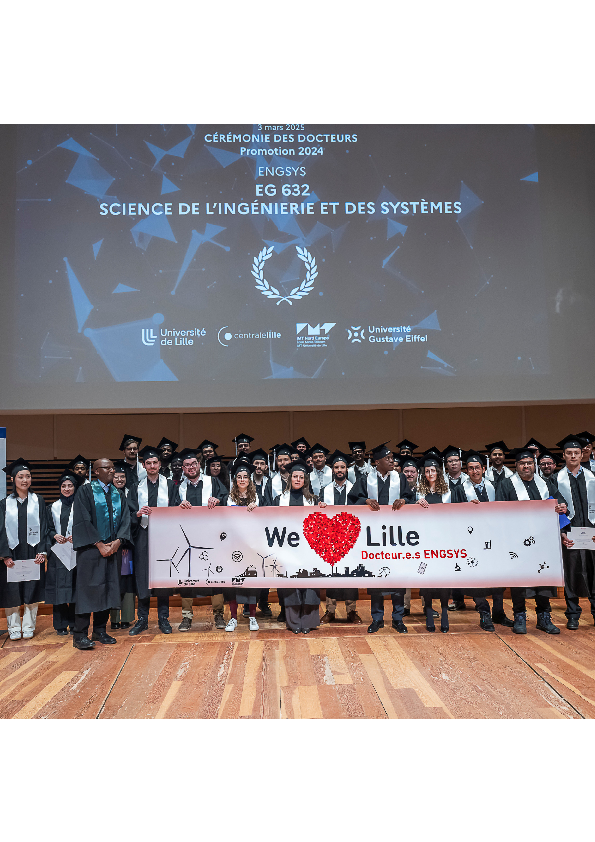
Soutenance : 17 décembre 2024
ECOLE CENTRALE DE LILLE, France
Haider ALI
Planification opérationnelle optimale d’une flotte de véhicules électriques autonomes
maximisant la recharge à base d’énergie renouvelable
Optimal Techniques for Smart Grid Charging of Autonomous Electric Vehicles using Renewable Energy
President :
Philippe DESSANTE, Professeur, CentraleSupelec, GeePs
Rapporteurs :
Jakob PUCHINGER, Professeur, Ecole de Management de Normandie
Raphael CAIRE, Maître de Conférences HDR, Grenoble INP, G2ELAB
Examinatrice :
Anne BLAVETTE, Chargée de Recherche du CNRS, ENS Rennes, SATIE
Encadrants:
Luce BROTCORNE, Directrice de Recherche, INRIA - Lille, INOCS
Bruno FRANCOIS, Professeur des Universités, Centrale Lille, L2EP
Membre invité:
Joao SOARES, Directeur de Recherche, GECAD, ISEP - Polytechnic Institute of Porto

Proclamation des résultats
Abstract:
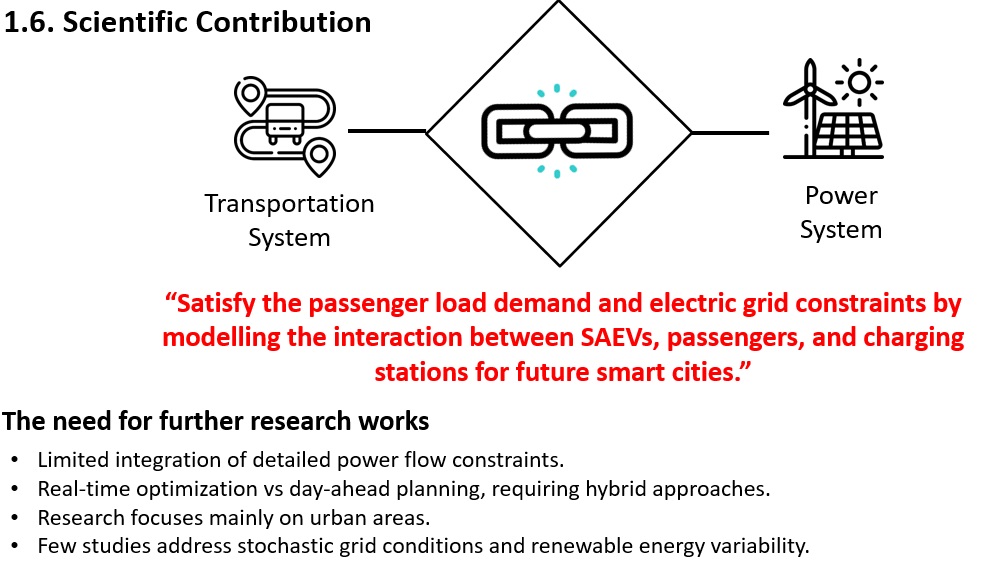
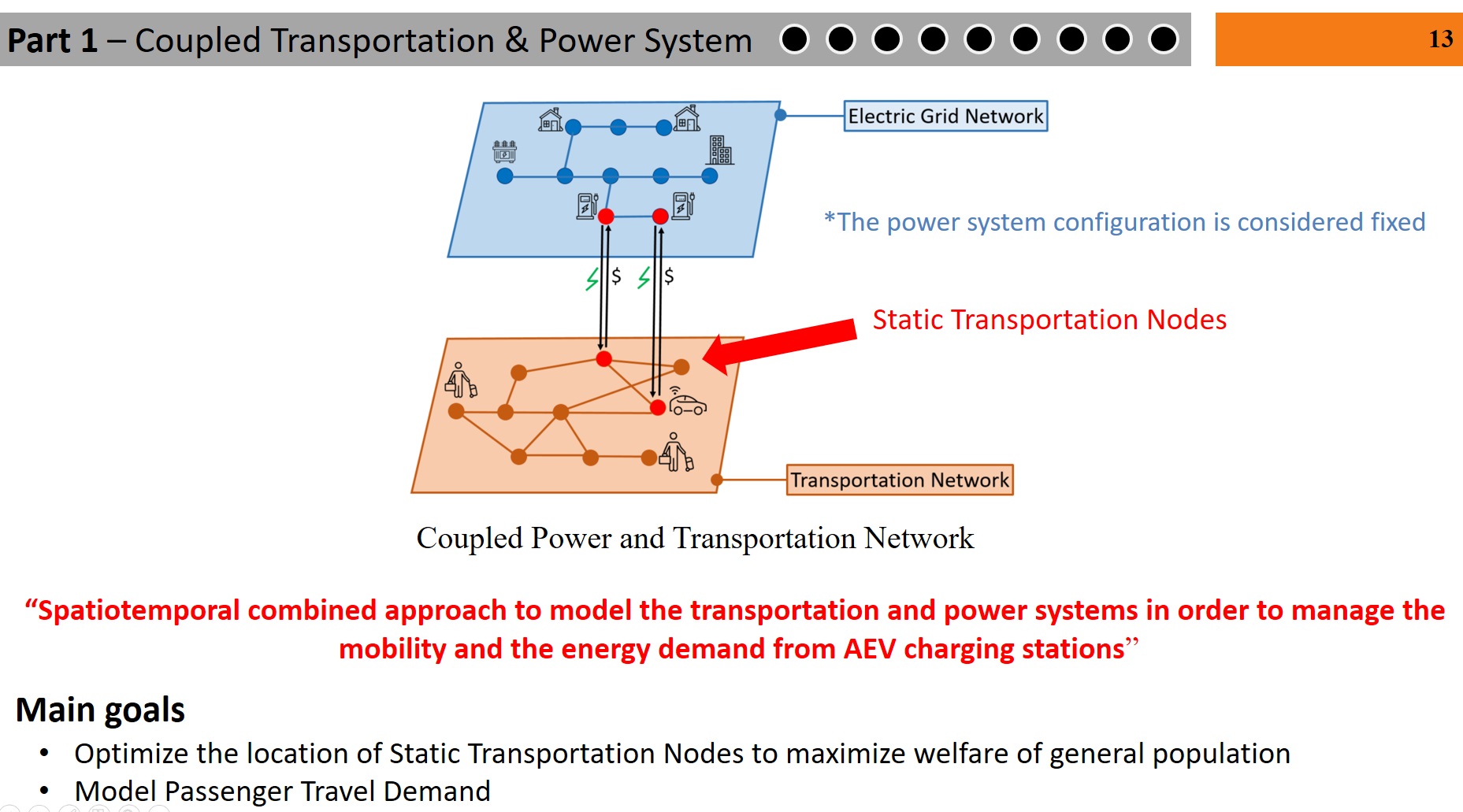
The increasing deployment of Shared Autonomous Electric Vehicles (SAEVs) and the integration of renewable energy sources into urban power grids present both opportunities and challenges for sustainable transportation systems. This thesis explores the optimization of coupled power and transportation networks, focusing on balancing passenger travel demand with electric grid constraints. A multi-faceted approach addresses the interactions between SAEVs, charging stations, passengers, and the power grid. The first contribution is modeling the transportation and power system as interconnected layers, optimizing the placement of static transportation nodes, such as AEV stops, using a P-Median approach to minimize the distance between passenger demand points and these nodes while adhering to grid limitations. The second contribution develops deterministic optimization strategies through the Vehicle Routing Problem with Time Windows (VRPTW), integrating passenger demand and grid pricing signals. This model determines the optimal fleet size and transportation network configuration, considering different charging pricing strategies, with a comparative analysis of advanced optimization techniques like route-building heuristics and exact methods. The third contribution incorporates uncertainties in electric grid load demand and renewable energy generation through stochastic optimization techniques. By applying Conditional Value at Risk (CVaR), the research accounts for power supply and demand fluctuations, particularly at localized charging stations, and evaluates the Value of Stochastic Solution (VSS) to compare deterministic and stochastic approaches for managing risk and uncertainty. The fourth contribution focuses on real-time grid management through dynamic optimization, allowing continuous adjustments to SAEV charging schedules based on real-time grid conditions, crucial for adapting to unpredictable grid demand and renewable energy changes. The evaluation of these optimization models uses key performance indicators like travel costs, passenger rejection, peak-hour charging, and final EV battery capacity. The results show that fixed pricing mechanisms are least effective, leading to grid overload, while Time-of-Use (TOU) rates encourage off-peak charging but are outperformed by dynamic pricing strategies, which reduce grid stress and costs, aided by renewable energy integration during peak hours. While exact algorithms work well for small instances, heuristic and metaheuristic methods provide scalable solutions for larger problems without sacrificing efficiency. This study emphasizes real-time, adaptable strategies to balance passenger demand, grid stability, and renewable energy integration, advancing sustainable urban mobility. Finally, the practical implementation of these models is demonstrated through software tools and simulations, offering a pathway for cities to enhance urban mobility while integrating renewable energy sources into the grid.
Résumé:
Cette thèse explore l'optimisation des réseaux couplés de transport et d'électricité, en se concentrant sur l'équilibre entre les demandes de déplacement des passagers et les contraintes du réseau électrique. Une approche holistique aborde les interactions complexes entre les Véhicules Autonomes Partagés Électriques (SAEV), les stations de recharge, les passagers et le réseau électrique. La première contribution est de modéliser ces réseaux tant que couches interconnectées, en optimisant le placement des nœuds de transport statiques, tels que les arrêts de véhicules autonomes électriques (AEV), à l'aide d'une approche P-Median. La deuxième contribution consiste à développer des stratégies d'optimisation déterministes via le problème de routage des véhicules avec fenêtres temporelles (VRPTW), en intégrant les réservations des passagers et la tarification de l’énergie électrique. La taille optimale de la flotte et la configuration du réseau de transport sont déterminées, tout en tenant compte des différentes stratégies de tarification de la recharge électrique. La troisième contribution inclut les incertitudes liées à la demande de recharge électrique des véhicules et à la production d'énergie renouvelable à travers des techniques d'optimisation stochastique. En appliquant l'optimisation de la Valeur Conditionnelle au Risque (CVaR), la recherche tient compte des fluctuations de l'offre et de la demande d'énergie et évalue la Valeur de la Solution Stochastique (VSS) pour comparer les approches déterministes et stochastiques dans la gestion du risque et de l'incertitude. La quatrième contribution se concentre sur la gestion en temps réel grâce à l'optimisation dynamique, permettant des ajustements continus des horaires de recharge des SAEV en fonction des conditions en temps réel du réseau électrique. L'évaluation des résultats d'optimisation repose sur des indicateurs clés de performance tels que les coûts de déplacement, le nombre de rejets de demande de mobilité, la recharge aux heures de pointe et la capacité finale des batteries des véhicules électriques. Les résultats montrent que les stratégies de tarification dynamique réduisent les contraintes sur le réseau électrique et les coûts opérationnels de mobilité. Ensuite, l’étude met en avant l'importance des stratégies adaptables en temps réel pour équilibrer la demande des passagers, la stabilité du réseau électrique et l'intégration des énergies renouvelables, faisant progresser la mobilité urbaine durable. Enfin, la mise en œuvre pratique est démontrée à travers un jumeau numérique, offrant aux villes une voie pour améliorer la mobilité urbaine tout en exploitant les sources d'énergie renouvelable.
Contenu :
Chapter 1: Introduction
Chapter 2: Modelling the Autonomous Electric Vehicle Fleet System
Chapter 3 : Formulation of a Vehicle Routing Problem including booking and AEV charging constraints
Chapter 4: Optimal Day Ahead Routing and Price-Based Charging Optimization for SAEV Fleet
Chapter 5: Incorporating Uncertainty in Fleet Optimization through Stochastic Models
Chapter 6: Adaptive Charging and Parking Coordination for Autonomous Electric Vehicles: A Rolling Horizon Framework
Conclusion and Future works
Publications:
Journals
[J1]
Shared autonomous electric vehicles day-ahead transit and charging optimization using TOU rates and renewable energy
Haider Ali, R Razi, B Francois, L Brotcorne
Sustainable Energy, Grids and Networks, Elsevier, June 2025, vol. 42, 101703, June 2025, 101703,
doi
preprint
International conferences
[C1]
Optimal siting and sizing of charging stations for autonomous electric vehicle fleet with local renewable energy generation,
Haider ALI, Bruno FRANCOIS, Luce BROTCORNE,
CIRED workshop on E-mobility and power distribution systems, Porto, 2022
doi
[C2]
Model Predictive Control for Smart Grid Charging of Autonomous Electric Vehicle Fleet using Local Renewable Energy Generation,
Haider Ali, João Soares, Bruno Francois, Luce Brotcorne
CIRED 2023 Roma, June 2023
[C3]
Optimal Planning of Autonomous Electric Vehicles Charging Stations with Photovoltaic Units and Energy Storage Systems in Electric Distribution Systems
Tayenne Dias de Lima, Haider Ali, João Soares, John F. Franco, Bruno Francois, Luce Brotcorne
IEEE ISGT 2023, October 23-26, Grenoble France
[C5]
Model Predictive Control for Smart Grid Charging of Autonomous Electric Vehicle Fleet using Local Renewable Energy Generation,
Haider Ali, João Soares, Bruno Francois, Luce Brotcorne
CIRED 2023 Roma, June 2023
[C.6]
Optimal Planning of Autonomous Electric Vehicles Charging Stations with Photovoltaic Units and Energy Storage Systems in Electric Distribution Systems
Tayenne Dias de Lima, Haider Ali, João Soares, John F. Franco, Bruno Francois, Luce Brotcorne
IEEE ISGT 2023, October 23-26, Grenoble France
doi
[C.7]
Optimal Day-Ahead Transport and Charge Scheduling of Autonomous Electric Vehicle Fleet using Local Renewable Energy Generation
Haider Ali, Bruno Francois, Luce Brotcorne
IEEE ISGT 2023, October 23-26, Grenoble France
doi