

Generalized Vectorial Formalism (GVF)
Within of the study of multiphase electric drives (with more than two independent currents) an approach was developed [1] in order to generalize the formalism of the Space Phasor adapted to inverter-machine systems having only two independent currents.
The GVF, Generalized Vectorial Formalism, thus makes it possible to model in a unified way the systems having multi-degrees of freedom. Here are some examples. An N-leg inverter is modelled by a vectorial polyhedron of dimension N (a hypercube) or an N-phase electric machine, by the eigenspaces and eigenvectors associated to eigenvalues of inductance matrix after a linear transformation. The machine supply is thus defined by a linear application between inverter space and machine space, with its core.
Concretely, a complex machine is represented by an association of several equivalent di-phase or single-phase machines. Two chapters, published in Wiley, were devoted to a presentation of the multiphase electric drives by this formalism [2] [3]. This approach was extended to the multi-actuator systems of Gantry type and the piezoelectric multi-actuator systems. Associated with the EMR (Energetic Macroscopic Representation), the GVF allows to obtain a decoupled representation of the systems, leading to a control scheme by inversion.
A relevant application of this approach, in addition to a real-time implementation of the optimal controls [4], consists to study multiphase drives in flux weakening mode where it is necessary to control the inverter very close to voltage saturation in order to exploit the DC-bus as well as possible. Thanks to the GVF, the machine voltage during flux weakening operation can be obtained according to a maximum given torque.
Within the SOFRACI project financed by FUI (Fonds Unique Interministériel in French), the objective is to develop a motorization for electric vehicle with integrated fast charger using the same traction components (motor and power electronics). Based on analytical models of the machine, a flux weakening strategy has been developed. The 3rd harmonic injection of voltage by taking into account of the inverter saturation, allows to obtain a higher torque for a given maximum current [5]. A 3D-representation of the inverter makes it possible to visualize the space of available voltage (see Fig. 1).
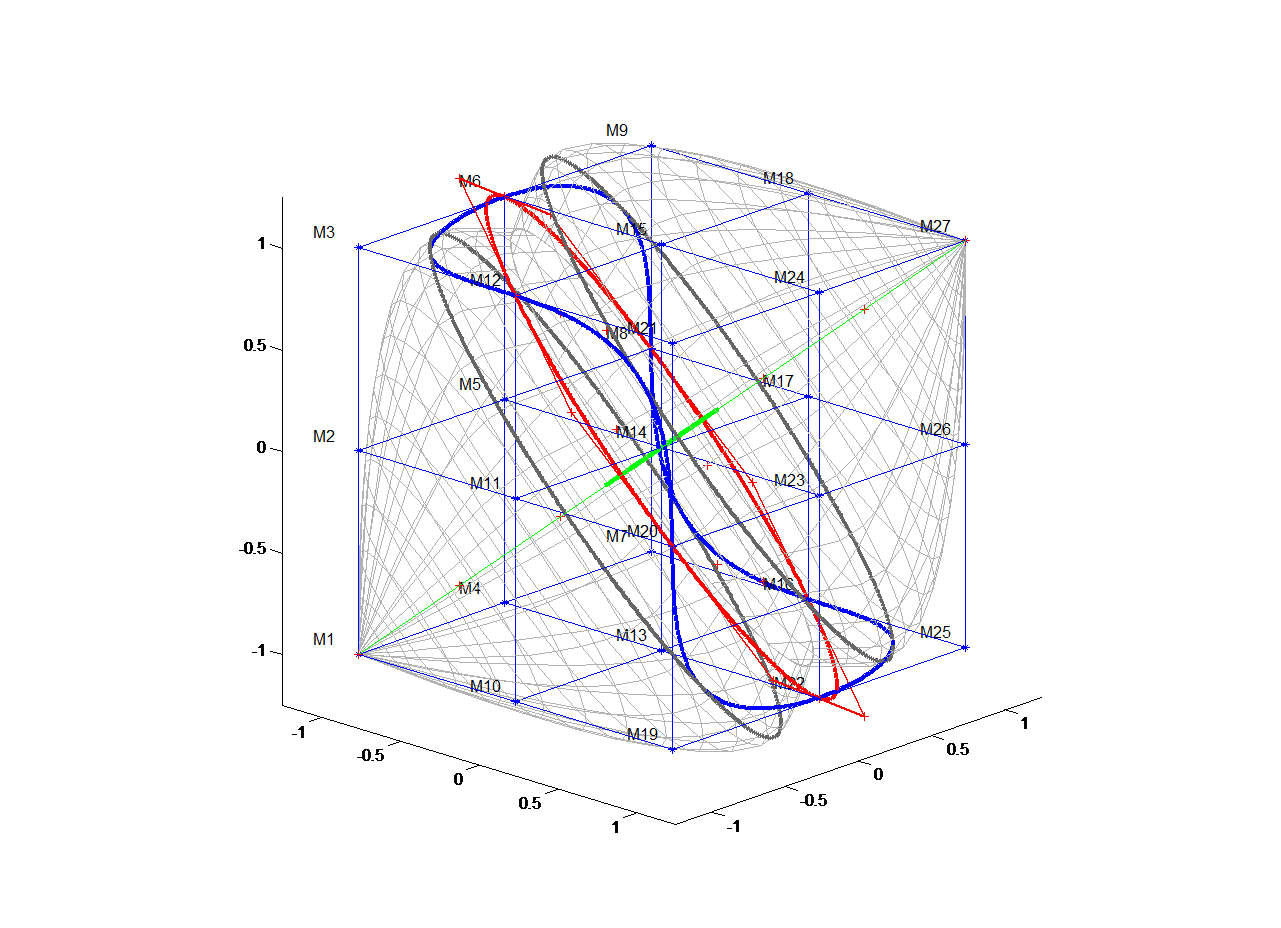
Space of available voltage for a 6-leg Voltage Source Inverter feeding a 3-phase machine (3 independent currents) in flux weakening with voltage saturation
A 48V, 10-15kW, 0-14000 rpm 5-phase machine has been also studied in the MHYGALE project funded by ADEME. With a speed range from 2000 rpm to 14000 rpm during the flux weakening operation, some control strategies, based on cartography approach, have been proposed [6] by injecting the 3rd and the 5th harmonic of voltage in steady state.
Used to make easier the control of multiphase or multi-actuator systems, the GVF is also a powerful tool for multiphase machine design. Indeed, analyzing the characteristics of equivalent machines or sub-systems allow to define a conceptual specification suitable for the control of these sub-systems (inductance values of the machine for example).

Example of a machine designed and controlled at the laboratory
References :
[O1] E. Semail, « Outils et méthodologie d’étude des systèmes électriques polyphasés. Généralisation de la méthode des vecteurs d’espace», Thèse de doctorat en Génie Electrique, 2000, Université des Sciences et Technologie de LILLE
http://tel.archives-ouvertes.fr/tel-00266256/
[O2] X. Kestelyn, E. Semail, “Multiphase Voltage Source Inverters” chap 8 in book “Static Converters”, ISBN. 978-1-84821-195-7. ISTE Ltd and John Wiley & Sons Inc, mars 2011, 27 pages.
http://eu.wiley.com/WileyCDA/WileyTitle/productCd-1848211953.html
[O3] X. Kestelyn, E. Semail , “Vectorial Modeling and Control of Multiphase Machines with Non-salient Poles Supplied by an Inverter”, Chap7 in book “ Control of Non-conventional Synchronous Motors”, ISTE Ltd and John Wiley & Sons Inc, ISBN: 9781848213319, 2012, 44 pages
http://eu.wiley.com/WileyCDA/WileyTitle/productCd-184821331X.html
[O4] X. Kestelyn, E. Semail, “A Vectorial Approach for Generation of Optimal Current References for Multiphase Permanent Magnet Synchronous Machines in Real-time”, IEEE Transactions on Industrial Electronics, Vol 58, N°11, pp5057-5065, Nov 2011. doi: 10.1109/TIE.2011.2119454 (https://hal.archives-ouvertes.fr/hal-00785154/document)
[O5] P. Sandulescu, F. Meinguet, X. Kestelyn, E. Semail, A. Bruyere, « Flux-weakening operation of open-end winding drive integrating a cost effective high-power charger”, IET Electrical Systems in Transportation (accepté pour publication nov 2012), 6-2013, pp.12? doi: 10.1049/iet-est.2012.0026 (https://hal.archives-ouvertes.fr/hal-00790157/document)
[O6] M. Trabelsi, N.K. Nguyen, E. Semail, “Real-time Switches Fault Diagnosis based on Typical Operating Characteristics of Five-Phase Permanent Magnet Synchronous Machines” , IEEE Transactions on Industrial Electronics, Vol 63, N°8, pp 4683-4694, August 2016, DOI 10.1109/TIE.2016.2554540, url (https://hal.archives-ouvertes.fr/hal-01314309/document)
[O7] T.J. Dos Santos Moraes, N.K. Nguyen, E. Semail, F. Meinguet, M. Guerin, “New Electrical Inversed-Series Connection for Even-Phase Symmetrical PMSMs “, Transaction on Power Electronics , Volume: 33, Issue 9, pp7938-7947, sept 2018, DOI : 10.1109/TPEL.2017.2766359, 9 url (http://hdl.handle.net/10985/13796)